National Day of Prayer 2026
National Day of Prayer – National and Local History
Linda Braun, Macedon Town Historian
May 7, 2026
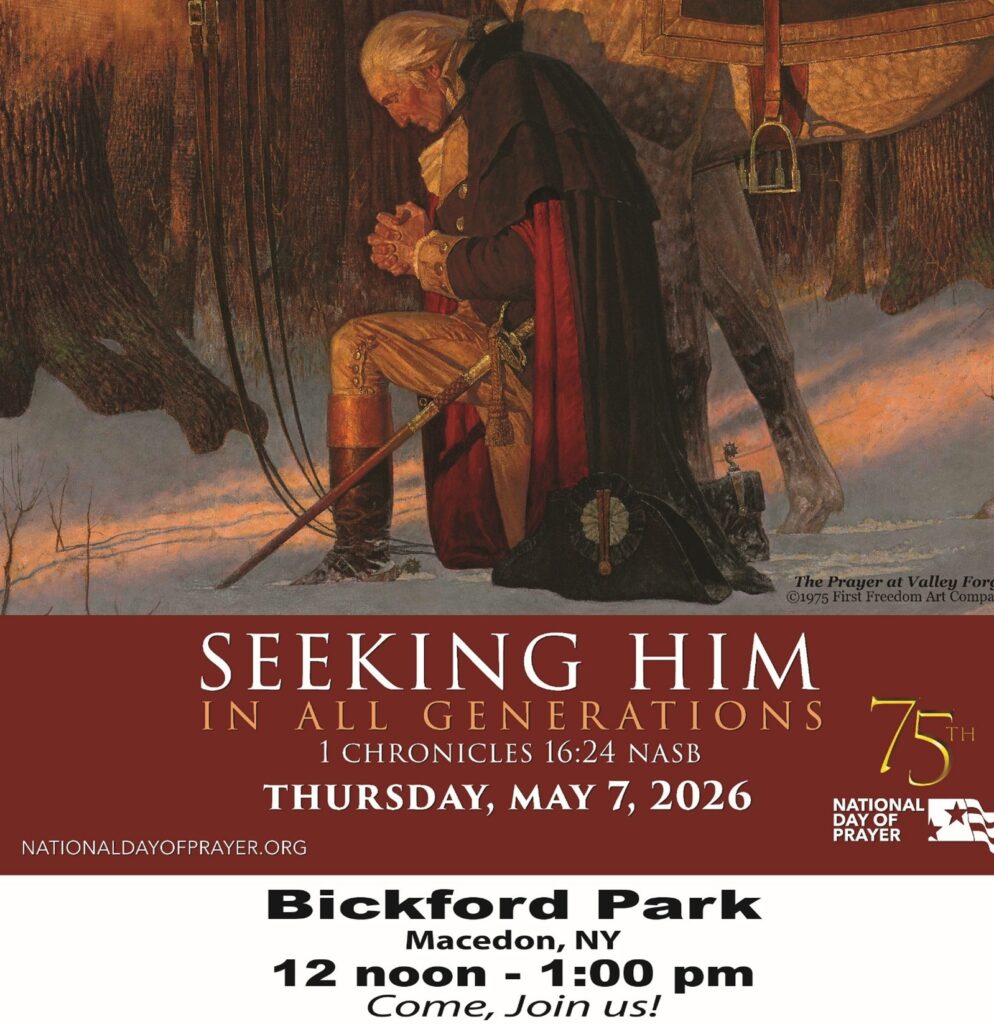
As we celebrate our country’s semi-quincentennial, or 250th birthday. I’d like to share the history of the National Day of Prayer, faith and action in our small part of our country. The National Day of Prayer website states: because of the faith of many of our founding fathers, public prayer and national days of prayer have a long-standing and significant history in American tradition.The Supreme Court affirmed the right of state legislatures to open their sessions with prayer in Marsh vs. Chambers (1983). The National Day of Prayer website provided me with some history: Since the first call to prayer in 1775, when the Continental Congress asked the colonies to pray for wisdom in forming a nation, the call to prayer has continued through our history. In 1863 President Lincoln’s proclamation of a day of “humiliation, fasting, and prayer.” In 1952, a joint resolution by Congress, signed by President Truman, declared an annual National Day of Prayer. In 1988, the law was amended and signed by President Reagan, permanently setting the day as the first Thursday of every May. Each year, the president signs a proclamation, encouraging all Americans to pray on this day.
https://www.nationaldayofprayer.org/about
Just over this hill to the north is the Erie Canal. We celebrated it’s 200th birthday in 2023. Like the NYS Thruway and highways of today, the Erie Canal brought all sorts of people to our area. The Erie Canal helped to speed up this process as people found more cost-effective and faster ways to travel. Many looking for opportunities not available in their hometowns. Along with that movement were people seeking to share the word of God with others - Evangelists. Our area became known as the Burned Over District. This term describes our area and the speed at which revivals and conversions were taking place.
The following is a timeline for the creation of places of worship in our town:
Macedon was home to the First Baptist Church organized in 1800. The Town of Macedon was founded in 1823. The Baptist members determination was so strong that they identified a way to move the original church building from Walworth Rd, across the canal to its current location on Main Street. Frederick Douglass spoke at the Baptist Church in August 1849 as part of an anti-slavery fair. In 1861 he spoke at the Macedon Academy in Macedon Center.
The Macedon Center United Methodist Church was organized sometime before 1825.
In 1856 St. Patrick’s Roman Catholic was founded as a mission in Macedon. It’s first church opening the following year. The Erie Canal and the influx of Irish Immigrants brought the need to establish a Roman Catholic parish in our town.
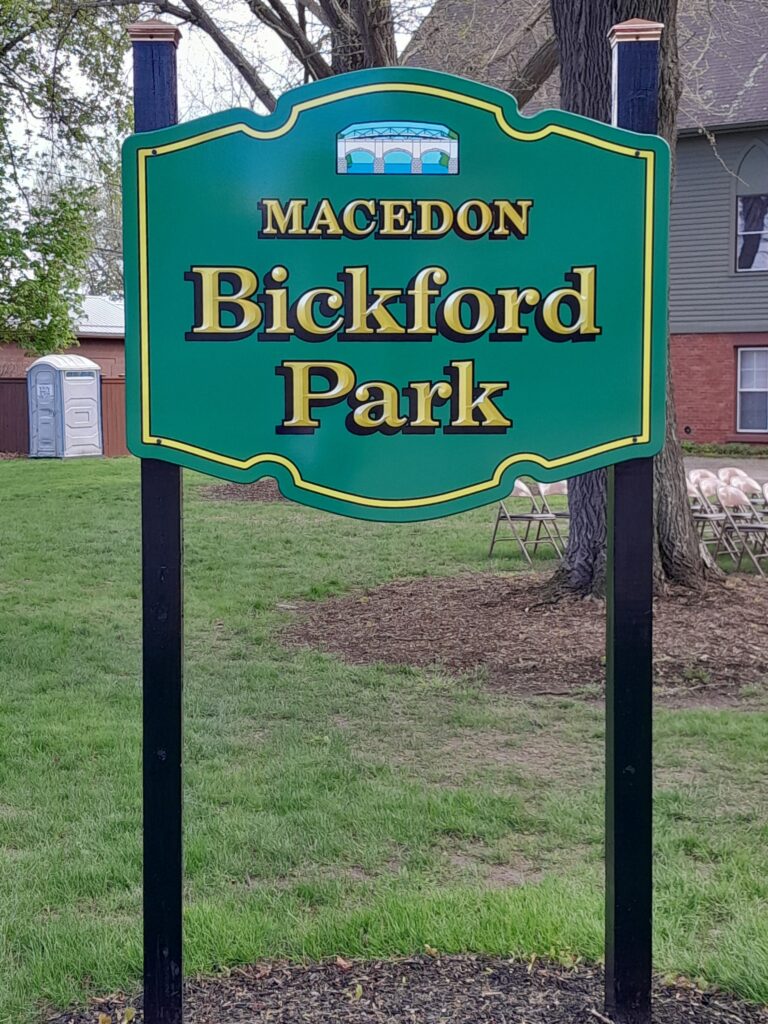
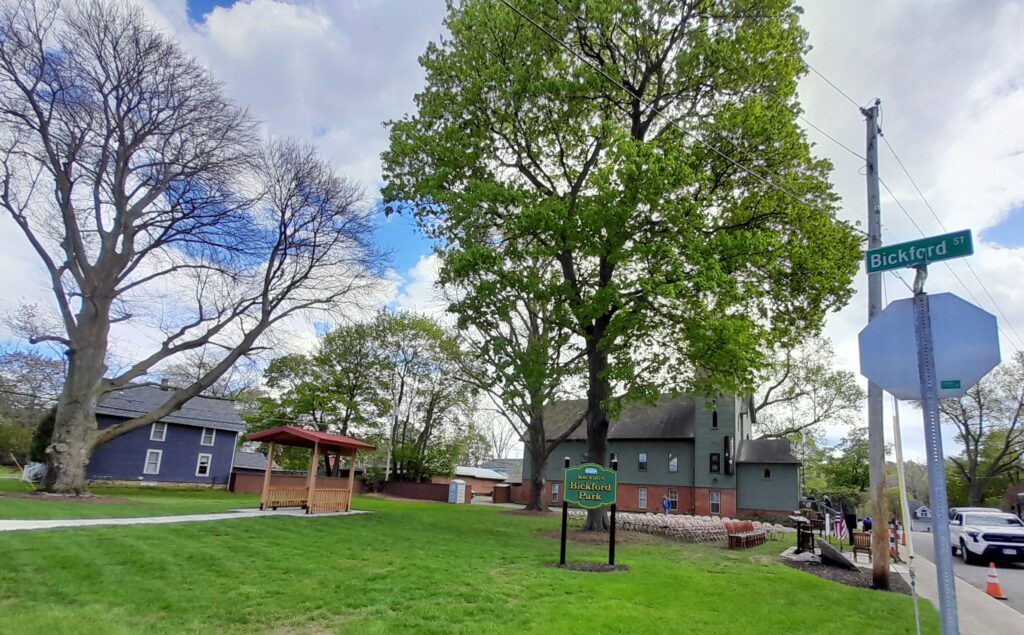
The building next to us is the former Universalist Church. Mr. Lyman Bickford, whose home was on the corner directly across the street, donated the land that it is built on to the Macedon Universalist Society. The building was finished and dedicated in May 1873. The church, named “The Church of the Good Shepherd,” was legally organized by Rev. Harvey Boughton on March 8, 1874. On August 19, 1961, the church property became the Town Hall of Macedon. In March of 1961 the Macedon Reading Center opened here. Just over ten years later in January 1972 the Reading Center was chartered as the Macedon Public Library. Mr. Joe Mazza purchased the building several years ago and has done a fantastic job, lovingly taking care to restore and preserve the architectural integrity. The Mission of 7 Center is to provide a place to Revitalize the Community Through Leadership Mentoring and Cultural Creativity.
Just down Route 31 to the east we come to Palmyra. What greets you as you enter the village are the famous 4 churches, originally, they were the Baptist, Methodist, Episcopal, and Presbyterian. Just behind the Presbyterian’s is St. Annes Roman Catholic Church, head south and you’ll come to the Reformed church as well as the Church of Jesus Christ of Latter-Day Saints founded by local resident Joseph Smith.
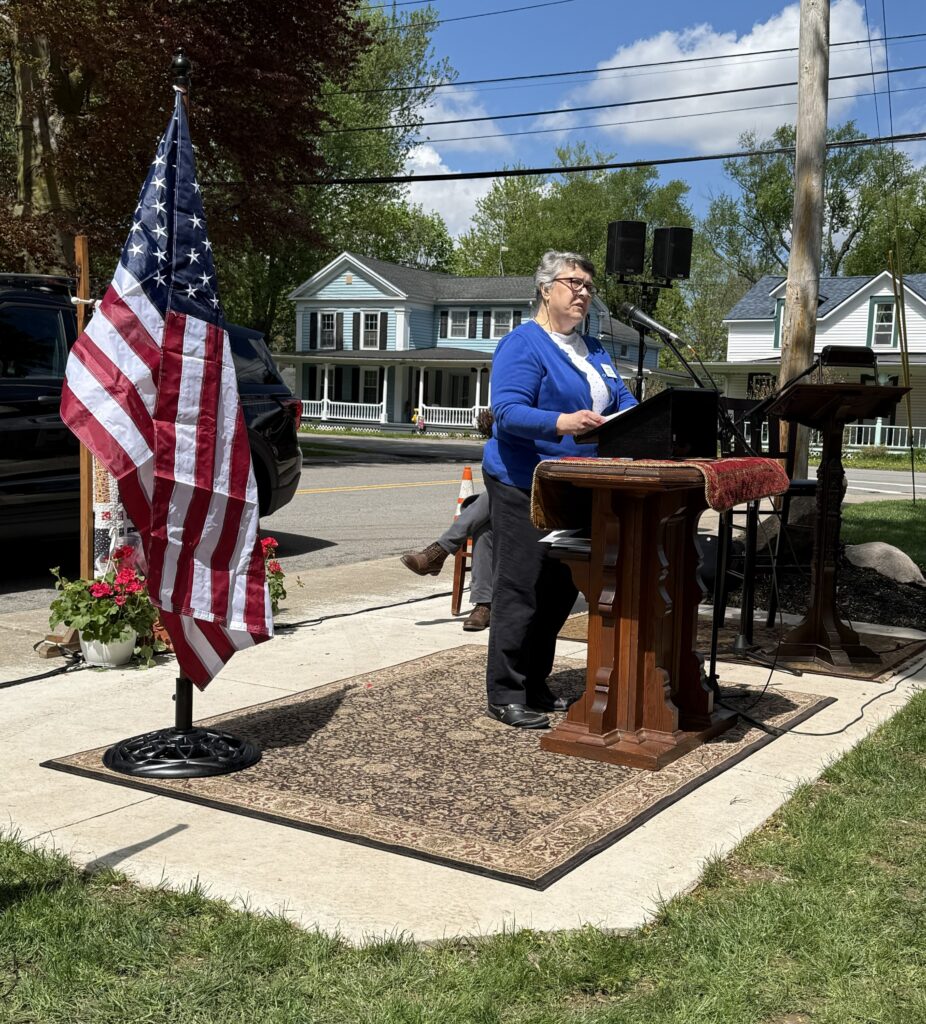
Some of these churches have changed denominations and new ones have been created. But their common purpose is to share the love of God with the people in our community. The demand for more places to worship was particularly strong in the Baptist and Methodist faiths Evangelist Charles Grandison Finney ordained originally as a Presbyterian and later a Congregationalist, held many revivals. For 7 months, from September 1830 to March 1831, he held a massive religious revival in Rochester, New York. People used the canal to travel from as far away as 100 miles to hear him speak. Today we are speaking from one of his pulpits. Thank you to the Finney School for letting us borrow it.
Not to be left out, south of us in the hamlet of Pumpkin Hook is the home of St. John’s Lutheran Church. Created by German immigrants, it began in 1879 as a mission post in the District No. 5 School House in Macedon, at the intersection of Victor and Canandaigua Roads, known as “Chimney Corners."(opens in new
Temperance: The prohibition of alcohol also grew in popularity during the late nineteenth century, and long before national prohibition. Temperance grew out of the conviction that alcohol was promoting crime along the Canal, and the movement found crossover support among abolitionists and women’s rights groups as well. Two Quaker Meetinghouses were located at the main intersection in Macedon Center. Also there, is the site of a Temperance Monument. It can be seen in front of the Macedon Center Meetinghouse located at 1208 Macedon Center Rd.
1816 Farmington Quaker Meetinghouse: Located just 3.9 miles south of us at the corner of County Rd 8 and Allen-Padgham Rds. A group of dedicated individuals is working hard to preserve this site and to educate people on its history and the activities that took place on this site over 200 years ago. Like people of Macedon this site also promoted the abolition of slavery and women’s suffrage.
Local residents Susan and Elias J. Doty were part of the core group of abolitionists, Underground Railroad supporters, and women’s rights activists affiliated with Farmington Monthly Meeting of Friends. Friends of Frederick Douglass were also signers of the Declaration of Sentiments at the nation’s first woman’s rights convention in Seneca Falls, July 19-20, 1848.
Wilber and Eliza Smith owned a home on Victor Rd. They were Quakers, Abolitionists, and Underground Railroad supporters. He later moved to Wilmington, DE in 1852. There Smith edited The Statesman abolitionist newspaper.
These people were just regular folk, taking a stand on what their beliefs were with how people should be treated.
The North Farmington Friends Meeting (Quaker), located across from the 1816 Meetinghouse sums up what I think is a very practical – inspirational way of explaining what we all might believe.
On their website, they state “Friends have found that listening to the light of Christ within us leads us to a common, Christ-centered way of living. English-speaking Friends often articulate our social commitments using the acronym of SPICES. These commitments are borne as spiritual fruit.
- Simplicity is the practice of laying aside all that hinders us. May we learn to desire one thing: commune with God and with one another.
- Peace is the practice of treating all life as sacred. May we value the life of each person as though it were our own.
- Integrity is the practice of telling and living the truth. May we always say what we mean and live up to what we say.
- Community is the practice of listening to each other and seeking truth together. May we be led together to live in the light as none of us could do alone.
- Equality is the practice of ensuring that all voices are heard and respected. May we be rooted in God's love for all people and willing to listen well.
- Service is the practice of love. May we love at every opportunity and always turn towards love.